What Is a Commodity? Definition and Examples
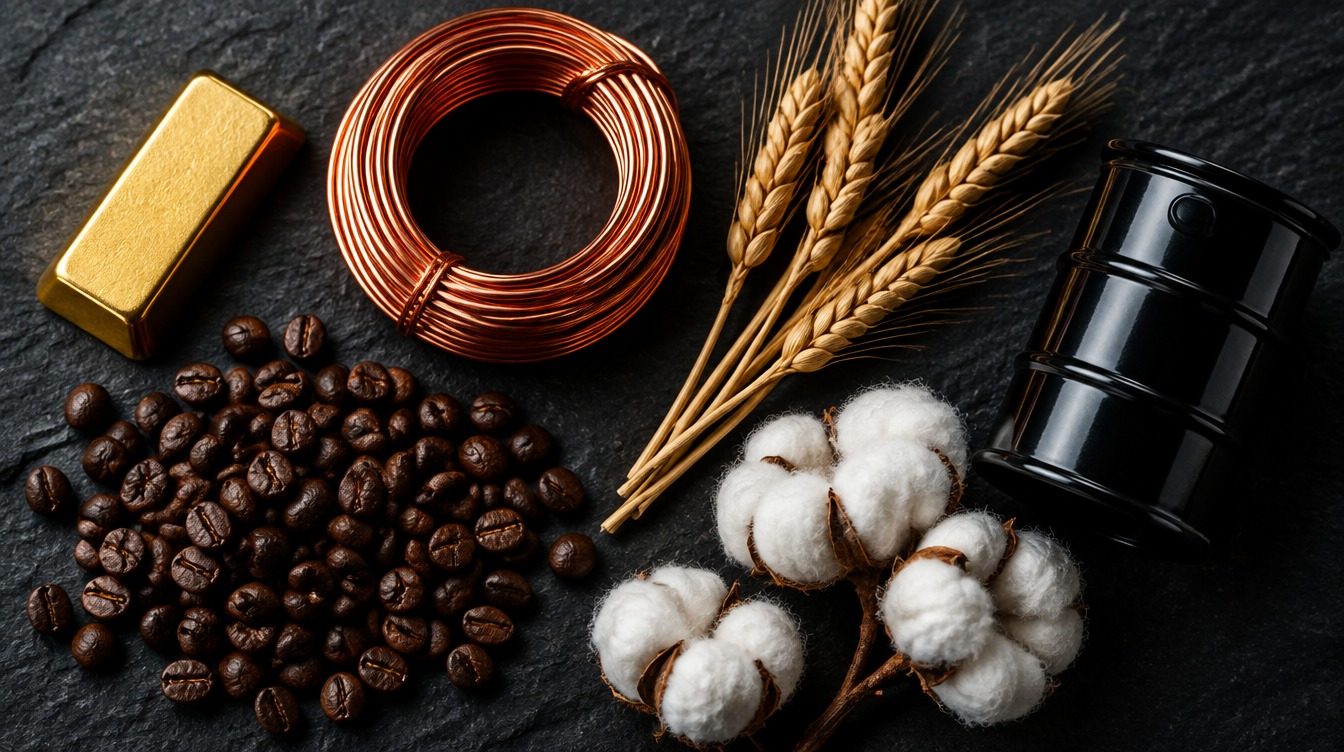
A commodity is a basic good or raw material that is interchangeable with other goods of the same type and grade. A barrel of a given grade of crude oil, an ounce of gold or a tonne of wheat is essentially the same whoever produced it, so it sells at a market price rather than on its brand. Commodities are the inputs that the rest of the economy is built from, and many are traded on exchanges through standardised futures contracts.
Key takeaways
- Commodities are fungible: one unit is a perfect substitute for another of the same grade.
- The four main groups are energy, metals, agriculture and livestock.
- Prices are set by supply and demand, and can be very volatile.
- Most commodity trading happens through futures, options and funds rather than physical delivery.
What does commodity mean in economics?
In economics, a commodity is a good whose units are treated as identical by buyers. Because there's little to distinguish one producer's output from another's, competition happens mostly on price. That's the key difference between a commodity and a branded product: a smartphone or a pair of trainers is differentiated, while copper cathode meeting an exchange's specification is not. The word is also used more loosely in business, where "commoditised" describes any product that has become hard to tell apart from its competitors, so prices fall.
Types of commodities, with examples
| Category | Examples | Main price drivers |
|---|---|---|
| Energy | Crude oil (WTI, Brent), natural gas, gasoline, heating oil, coal | Global growth, OPEC+ supply, weather, inventories |
| Precious metals | Gold, silver, platinum, palladium | Interest rates, the US dollar, safe-haven demand, jewellery and industry |
| Industrial metals | Copper, aluminium, zinc, nickel, iron ore | Construction, manufacturing, China's economy |
| Agriculture (grains and softs) | Wheat, corn, soybeans, coffee, sugar, cocoa, cotton | Harvests, weather, crop reports, trade policy |
| Livestock | Live cattle, feeder cattle, lean hogs | Feed costs, disease, consumer demand |
Traders often split them into hard commodities, which are mined or extracted (energy and metals), and soft commodities, which are grown or raised (crops and livestock).
Is gas a commodity?
Yes, in both senses. Natural gas is one of the most heavily traded energy commodities, with benchmark futures such as Henry Hub in the US. Gasoline (petrol) is a refined product that also trades as a commodity on futures exchanges. The fuel you buy at the pump is priced partly from these wholesale markets, plus refining margins, transport and taxes.
What makes something a commodity?
- Standard grades that buyers and sellers agree on, such as a minimum purity for gold.
- Many producers, so no single seller can set the price.
- Storable or deliverable in a predictable way, which lets futures markets work.
- Broad demand from industry or consumers around the world.
Things that are unique, such as artwork or a specific property, are not commodities.
What moves commodity prices?
Commodity prices react to the physical balance between supply and demand, which can shift fast. A drought can lift wheat; a production cut can lift oil; a slowing economy can sink copper. The US dollar matters too, because most commodities are priced in dollars: a weaker dollar tends to make them cheaper for other buyers and supports prices. Some currencies move closely with commodity prices; the Australian and Canadian dollars are known as "commodity currencies", and they're most active during the sessions covered in our guide to forex market hours.
How are commodities traded?
- Spot (physical) markets: buying the actual commodity for immediate delivery, mostly done by producers and industrial users.
- Futures contracts: standardised agreements to buy or sell a set amount at a future date, traded on exchanges such as CME Group and ICE. The CFTC's basics of futures trading explains how they work.
- Options on futures: the right to buy or sell a futures contract at a set price.
- ETFs and funds: track a commodity or a basket, often through futures.
- Shares of producers: miners, oil companies and farm businesses.
- CFDs and spread bets (outside the US): price-only exposure. Our guide to investing in gold with spread betting shows one example.
Gold has its own global market structure, spanning London's over-the-counter market, futures exchanges and central banks; the World Gold Council explains it in gold's global trading market.
Commodities vs currencies and stocks
Unlike a share, a commodity produces no earnings or dividends; its value is whatever the market will pay for it today, or for delivery later. Unlike a currency, it's a physical thing with storage and transport costs. That's why commodities behave differently from both, and why some investors hold a small allocation for diversification or as a hedge against inflation. For a refresher on how currency markets compare, see how foreign exchange trading works.
FAQ
What is a commodity in simple terms?
A basic product, like oil, gold or wheat, that's the same no matter who makes it, so it's bought and sold mainly on price.
What is a commodity in finance?
In finance, a commodity is a raw material that can be traded on markets, usually through futures contracts, as an investment, a hedge or for speculation.
What are the most traded commodities?
Crude oil is the most actively traded, followed by natural gas, gold, copper, and grains such as corn and soybeans.
Is money a commodity?
Modern money isn't, but historically gold and silver coins were "commodity money" whose value came from the metal itself.
General information only, not financial, tax or legal advice. Trading leveraged products carries a high risk of losing money.